Best Time to Visit Niagara Falls
Month-by-month guide to Niagara Falls from Toronto: when the boats run, when crowds peak, November and winter, and morning or evening.
The short answer: June to early October, if you want the boat into the Horseshoe Falls basin with warm weather and every attraction open. Late May and September are the same experience with thinner crowds. Winter (mid-November to March) gives up the boats and gains the ice, the Winter Festival of Lights and empty viewpoints; Journey Behind the Falls stays open all year. The Niagara Falls day tour from Toronto runs in every season and swaps its attractions to match.
The Core Decision: Boat Season vs Off-Season
The biggest variable is the boat. On the Canadian side, Niagara City Cruises runs the Voyage to the Falls, a 20-minute trip past the American and Bridal Veil Falls into the mist at the foot of the Horseshoe Falls. Niagara Parks lists it as seasonal, April to November, and the operator adds December sailings only when the weather allows; the exact first and last days move with the river ice each year. The fare at the dock was CA$47.95 for an adult (13+) and CA$32.95 for a child (3 to 12), plus 13% HST, when we checked Niagara Parks in October 2026.
The American boat, Maid of the Mist, runs a shorter season. In 2026 it sailed from 24 April to Sunday 8 November, at US$30.25 for an adult and US$19.75 for a child aged 6 to 12 (Maid of the Mist, checked October 2026). It leaves from the Observation Tower in Niagara Falls State Park, New York, so from the Canadian side it means crossing the border with a passport. The Niagara City Cruises vs Maid of the Mist guide compares the two.
Outside the boat season, the Toronto day tour replaces the boat with Journey Behind the Falls in its one-attraction package, or with Niagara Takes Flight, the flying-theatre ride beside the falls, in its two-attraction package. Journey Behind the Falls takes you 38 metres (125 feet) down through the rock to portals behind the Horseshoe Falls, and Niagara Parks keeps it open every day of the year.
Season by Season
Summer (June–August): Peak Season
Summer is the busiest window and the one with the longest days.
What’s happening:
- Both boats run full schedules (Maid of the Mist sails until 8 pm on summer evenings)
- Journey Behind the Falls is open, with its longest lines in July and August
- Average highs around 24–26°C, so a soaking on the boat deck is welcome rather than cold
- Fireworks over the falls every night at 10 pm through the summer series, which ran from mid-May to mid-October in 2026 (Niagara Falls Tourism)
Who it’s right for: first-time visitors who want the full experience: boat, warm weather, the evening illumination and fireworks.
Who should skip summer: anyone crowd-sensitive. July and August are the school holidays on both sides of the border. Skip-the-line access to the boat and Journey Behind the Falls, which the Toronto day tour sells as an upgrade, makes the biggest difference in these months.
Spring (April–May): Lower Crowds, Big Water
April and May have noticeably smaller crowds than summer, with average highs of about 12°C in April and 19°C in May. Snowmelt keeps the river high, and the falls look heavy and white.
The boat caveat: the first Canadian sailings depend on the ice. Visit in April and you may find the boats not yet running; the tour then uses Journey Behind the Falls or Niagara Takes Flight. By late May both boats are on the water.
April in particular is underrated: powerful falls, green riverbanks and short lines. Bring a layer, because the mist adds a chill at the viewpoints.
Autumn (September–October): Ideal Conditions
September and October are, for many visitors, the best months:
- Both boats still run (Maid of the Mist until early November, Niagara City Cruises into November)
- Summer crowds thin out after Labour Day, the first Monday in September
- Average highs of about 22°C in September and 16°C in October, comfortable for walking the gorge
- The Niagara wine region is in harvest, and the trees along the escarpment turn in October
October hits a sweet spot: boats running, colour on the gorge rim, nightly fireworks in the first half of the month, and far fewer people than in August.
November: The Changeover Month
November is when the season turns, and the dates matter:
- Maid of the Mist makes its last 2026 sailings on Sunday 8 November.
- Niagara City Cruises keeps sailing into November, weather permitting; check the booking calendar for the day.
- Cave of the Winds on the American side switches to its winter rate from 19 October 2026: US$14 for an adult and US$10 for a youth, against US$23 and US$19 in summer (Niagara Falls State Park). Tickets are sold on Goat Island, not online.
- The Winter Festival of Lights opens on 14 November 2026 and runs to 10 January 2027, free, with fireworks at 8 pm on Fridays and Saturdays from 14 November to 12 December, nightly from 18 December to 2 January, and on 8 and 9 January (Niagara Falls Tourism).
Average highs fall to about 9°C and lows to about 1°C, so dress for wind and spray.
Winter (December–March): A Different Experience
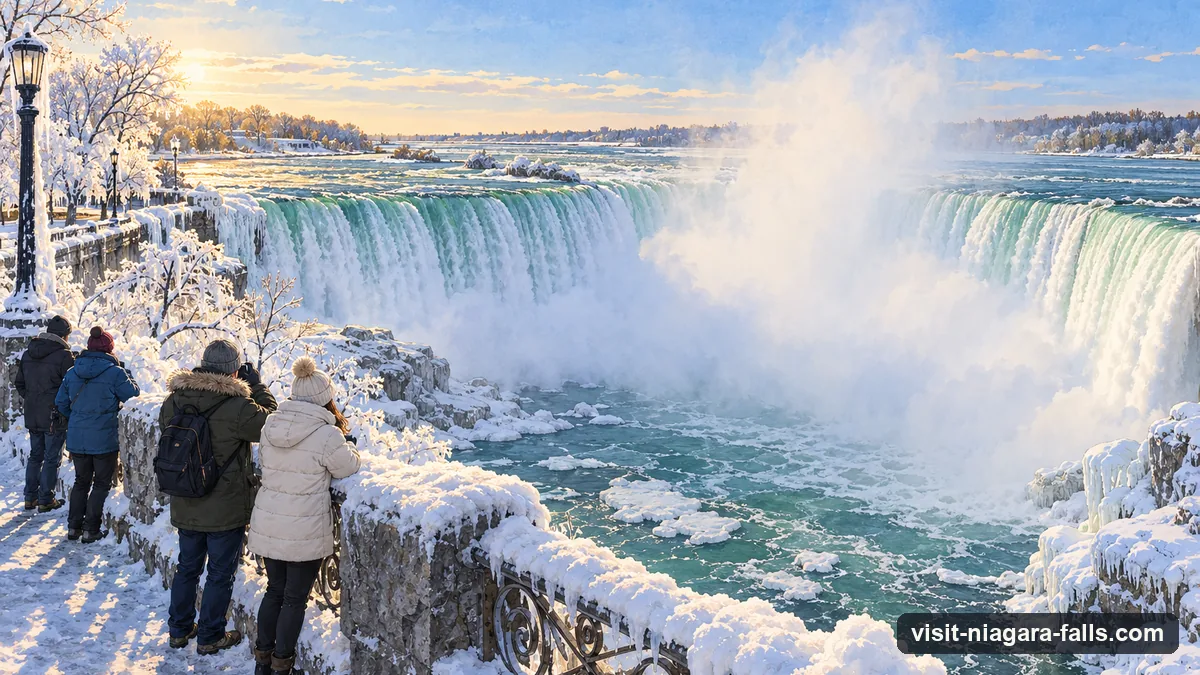
Winter at Niagara Falls is genuinely spectacular, just different. The falls do not stop: water keeps pouring over the crest all winter, but frozen mist coats the railings, the trees and the rocks along the gorge, and ice piles up below the falls in a cold January or February.
What you gain in winter:
- The Winter Festival of Lights until 10 January, and the nightly illumination of the falls
- Short lines and quiet viewpoints
- Journey Behind the Falls is open every day, with the ice along the gorge in view
- Cave of the Winds runs at its winter rate on the American side
What you give up:
- No boats on either side
- The lower deck of Journey Behind the Falls can close for ice; Niagara Parks is building a new heated, year-round viewing platform in a restored century-old tunnel, due in 2027, and rebuilding the lower deck by 2028, with the attraction open throughout
- Average lows of about -8°C in January and February, and colder in a cold snap
- Less time comfortable at the outdoor viewpoints
The day tour runs in winter too: the coach is heated, and Journey Behind the Falls and the maple syrup tasting become the centrepieces.
Month-by-Month Quick Reference
| Month | Boats | Crowds | Average low to high | Highlight |
|---|---|---|---|---|
| January | ✗ | Very low | -8 to 0°C | Ice along the gorge; Festival of Lights to 10 Jan |
| February | ✗ | Very low | -8 to 1°C | Peak ice; quietest month |
| March | ✗ | Low | -4 to 5°C | Ice clearing |
| April | Weather permitting | Low–moderate | 1 to 12°C | High spring water; short lines |
| May | ✓ | Moderate | 8 to 19°C | Boats running; nightly fireworks from mid-May |
| June | ✓ | Moderate–high | 13 to 24°C | Full summer season begins |
| July | ✓ | Very high | 16 to 26°C | Peak crowds, longest evenings |
| August | ✓ | Very high | 16 to 26°C | Warmest and busiest |
| September | ✓ | Moderate | 12 to 22°C | Crowds drop after Labour Day |
| October | ✓ | Low–moderate | 6 to 16°C | Fall colours; summer fireworks end mid-month |
| November | Canadian boat only after the 8th | Low | 1 to 9°C | Festival of Lights from 14 Nov |
| December | Weather permitting | Low | -4 to 3°C | Festival of Lights; illumination |
Temperatures are the 1991–2020 averages of daily lows and highs at Fort Erie, Ontario, upriver from the falls (Environment and Climate Change Canada). Boat columns follow the 2026 seasons above.
Quick Answers
Is it better to visit Niagara Falls in the morning or the evening?
Both, for different reasons. Mornings have the shortest lines: from June to August, Skylon Tower and the zipline both suggest arriving before 11 am. Evenings have the illumination every night and, from mid-May to mid-October, fireworks at 10 pm; in winter the Festival of Lights fireworks start at 8 pm. A good summer day does the boat and Journey Behind the Falls early and comes back to the brink after dark.
What is the best month to visit Niagara Falls from Toronto?
September, for most people: boats running, warm days, school-holiday crowds gone. The Toronto to Niagara Falls day trip guide covers the tour, the GO train and driving.
Is Niagara Falls worth visiting in November?
Yes, with the right expectations. The first week still has both boats; after 8 November only the Canadian boat runs, weather permitting, and from 14 November the Winter Festival of Lights fills the evenings. Days are short and cold, the lines are short too.
Does Niagara Falls freeze in winter?
No. The water keeps flowing, but the spray freezes on everything around it, and ice builds up in the river below the falls in a hard winter. Seen from Table Rock or from the portals of Journey Behind the Falls, it is a sight summer visitors never get.
Is the Canadian side open in winter?
Yes. The viewpoints along the Niagara Parkway, Journey Behind the Falls, Niagara Takes Flight and Skylon Tower are open; only the boats stop. The Journey Behind the Falls page has hours and tickets.
What the Tour Operates Year-Round
The Niagara Falls day tour from Toronto runs from about 8:00 am to 5:30 pm in every season, with three to four hours at the falls. Its attraction packages follow the calendar: the boat when it runs, Journey Behind the Falls or Niagara Takes Flight when it does not. It started at US$57 a person when we checked in April 2026, with free cancellation.
Ready to Book?
Pick your date first, then the package: see the Toronto day tour's dates and attraction packages, or browse all Niagara Falls tours, from the Skylon Tower deck to the zipline to the falls.
Visit Niagara Falls — Day Tour from Toronto
Join 2,605+ guests who rated this experience 4.8/5. Horseshoe Falls, boat cruise, Journey Behind the Falls, maple tasting, and round-trip transport from Toronto — all in one day. From US$57 per person with free cancellation.
Check Availability & Book